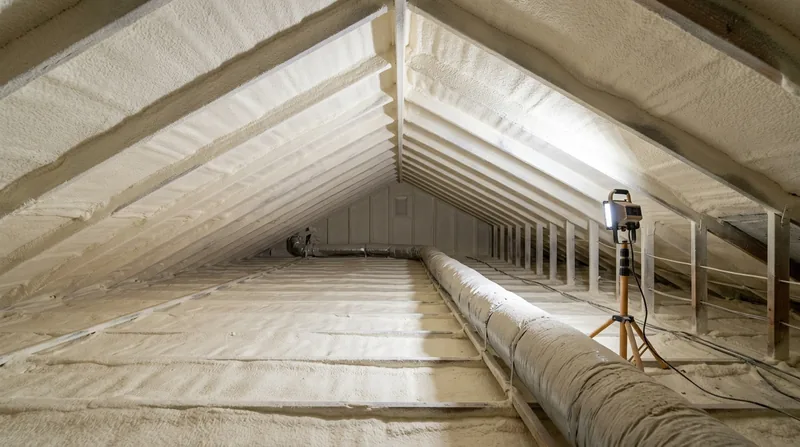




Attic spray foam insulation in El Paso transforms a 150-degree furnace into conditioned space, pulling ductwork for refrigerated air or swamp coolers inside the thermal envelope where they belong. From May through September, El Paso attics hit 140 to 160 degrees Fahrenheit, and that heat pours down through fiberglass batts, blown-in cellulose, or worse, nothing at all. The high Chihuahuan Desert climate swings from 100-degree days to freezing winter nights, and spring wind kicks dust and debris into every unsealed attic. Whether your home is a 1900s brick bungalow in Kern Place, a 1950s ranch in Central El Paso, or a new two-story in Tierra del Este, open-cell foam on the roof deck seals air leaks, stops radiant heat, and keeps your conditioned air where you paid for it. We spray foam insulation and air seal attics across El Paso, Horizon City, Socorro, San Elizario, Canutillo, Anthony, Clint, Fabens, and the surrounding valley, with every estimate listing the R-value, thickness per pass, and board footage so you know exactly what you are getting.
Why Attic Spray Foam Insulation Matters in El Paso's Desert Climate
El Paso sits at nearly 4,000 feet in the high desert, and almost every home sits on a concrete slab with pitched roofs that channel heat straight into an attic with little or no air sealing. The summer monsoon brings sudden storms and roof leaks on flat roofs; spring wind drives dust into every gap. Standard fiberglass batts settle and compress over time, leaving gaps at the joists and creating thermal bridges where heat flows straight through. Blown-in cellulose absorbs moisture and sags, leaving voids along the walls and rim. Spray foam adheres to every surface, fills every void in a single pass, and creates an air barrier that stops infiltration at the source.
- Seals air leaks around ductwork, electrical penetrations, and rim joists where conditioned air escapes.
- Reflects radiant heat from the roof deck, cutting the cooling load during the brutal May-to-September season.
- Prevents dust and pollen from settling into insulation and circulating through your home.
- Stops convection currents that move hot air down into living spaces on west-facing walls.
- Works year-round in El Paso's temperature swings, from freezing winter nights to summer heat.
A sealed attic with foam insulation is the single most cost-effective way to lower your cooling bills and keep your home comfortable when the desert heat peaks.
Local insight: In Horizon City and the Far East side, newer two-stories with long duct runs to bonus rooms suffer the worst heat gain because ductwork runs through an unconditioned attic for 40 to 60 feet. Spray foam on the roof deck and around the rim brings that ductwork inside the thermal envelope and cuts the load on the air conditioning system by 20 to 35 percent.
For detailed guidance on energy code compliance and thermal barriers in El Paso, see the City of El Paso Development Services website for current building code requirements at your address.
How We Spray Foam and Air Seal Your El Paso Attic
Every attic is different. Some homes have open rafter bays with clear access; others have obstructed joist cavities, ductwork, and electrical runs. We start with a site inspection to measure the attic space, identify air leaks, check for existing insulation that needs removal, and confirm what the building code requires at your address. We then provide a written estimate with the R-value, thickness per pass, and total board footage so you understand the scope and the cost before we spray a single inch.
- We inspect the attic, identify air leaks around penetrations, and confirm the roof and substrate are dry and sound.
- We remove any failed insulation, debris, or contamination that would prevent adhesion or create a moisture trap.
- We set up mechanical ventilation during the spray and cure process to manage off-gassing.
- We spray open-cell or closed-cell foam to the specified thickness, with each pass applied at the manufacturer ratio and drum temperature.
- We seal rim joists, band joists, and the perimeter of ductwork with foam and caulk to stop air infiltration.
- We provide a re-entry window of 24 to 48 hours before the attic is safe for occupancy or storage.
The result is an attic that stays sealed, stays clean, and keeps your conditioned air from leaking into the desert.
Example: A 1950s ranch in Northeast El Paso with a 1,200-square-foot attic, original fiberglass batts, and a 60-foot duct run to a bedroom addition. We removed the settled batts, sealed the rim joists and electrical penetrations with closed-cell foam, and sprayed the roof deck with open-cell foam to R-38. Total board footage: 1,440 BF. Cooling load dropped, and the bedroom stayed 8 to 10 degrees cooler by July.
For more detail on how we approach air sealing and the role it plays in energy efficiency, see our air sealing service page.
Attic Spray Foam Insulation Methods: Open-Cell vs. Closed-Cell
| Foam Type | Description | Best for El Paso Attics |
|---|---|---|
| Open-Cell Foam | Lower density, semi-rigid, air-permeable once cured. R-value approximately 3.6 per inch. Absorbs sound and is more forgiving during application. | Sealed attics on pitched roofs where the substrate is dry. Reduces cooling load and sound transmission from roof noise and HVAC equipment. |
| Closed-Cell Foam | Higher density, rigid, vapor-impermeable. R-value approximately 6 to 7 per inch. Adds structural strength and resists moisture. | Rim joists, band joists, and attic edges where condensation risk is highest. Also used in sealed attics with tight thickness requirements. |
| Removal and Replacement | Complete removal of failed or contaminated insulation, substrate cleaning, and new foam application. Addressed separately if asbestos testing is flagged. | Homes with settled fiberglass, failed blown-in, or pest damage. Common in Central and Northeast El Paso ranch homes built 1950 to 1980. |
| Combination Approach | Closed-cell on rim joists and band joists, open-cell on the roof deck. Balances cost, R-value, and air sealing performance. | Most El Paso attics. Stops infiltration at the perimeter and provides thermal resistance on the largest surface area. |
Both foam types meet code when installed correctly. The choice depends on your attic substrate, moisture risk, and budget. We help you choose the right method for your home and your climate.
Attic Spray Foam Insulation Cost in El Paso: What to Expect
Attic spray foam insulation in El Paso typically starts at $1.50 per square foot and rises based on attic size, existing insulation removal, access difficulty, and the R-value you need. A 1,200-square-foot attic on a pitched roof with clear access and no removal runs $1,800 to $2,400 before permits and inspection. If you need closed-cell foam on rim joists or have to remove failed insulation first, the cost rises. Tight attics, multiple obstructions, or high R-value requirements push the per-square-foot rate higher. Every estimate we provide includes the R-value, thickness per pass, and total board footage, so you know what moves the price and why.
Factors that affect your final cost include:
- Attic size and whether you are sealing the entire roof deck or just rim joists and band joists.
- Existing insulation that must be removed before foam can be applied.
- Access and obstructions like ductwork, electrical runs, and plumbing that require careful navigation.
- Whether you need open-cell, closed-cell, or a combination approach.
- Local permit requirements and whether a thermal barrier is mandated by code at your address.
The best way to know your cost is to get a written estimate from a contractor who measures your attic on site and specifies the R-value and thickness. We provide free estimates with no obligation, and we respond within 24 hours. See our pricing page for more detail on what affects the final cost.
What to Look for When Hiring a Spray Foam Insulation Contractor Near El Paso
The spray foam insulation market in El Paso includes local shops, national franchises, and rig-and-run crews that spray a job in an afternoon and disappear when the smell will not go away. A good contractor is reachable, shows up on time, and stands behind the work. Before you hire, ask for a written estimate that lists the R-value, thickness per pass, and total board footage. Verify that the contractor carries liability insurance and can provide a certificate on request. Ask for references from recent jobs in your neighborhood. Confirm what permits your city requires and whether the contractor will help you navigate the process. If your home is in a master-planned community with HOA rules, ask whether the contractor is familiar with architectural restrictions on your property.
- Request a written estimate that specifies R-value, thickness, and board footage so you can compare apples to apples.
- Verify that the contractor carries fully insured liability coverage and can provide proof on request.
- Ask for references from at least three recent jobs in El Paso and follow up with those homeowners.
- Confirm what permits your city requires and whether the contractor will coordinate with the building department.
- Ask about the mechanical ventilation and re-entry window during the spray and cure process.
- Get a timeline in writing and confirm that the contractor will not promise immediate re-entry or occupancy.
A contractor who takes time to inspect your attic, provides a detailed estimate, and answers your questions about permits and process is the one to hire. Contact us for a free estimate and to ask any questions about how we work. Call (915) 213-7582 or visit our contact page to schedule an inspection.
Attic Spray Foam Insulation in El Paso: Pricing Guide
| Service | Price | Details |
|---|---|---|
| Attic Spray Foam (Open-Cell) | Starting at $1.50/sq ft | Sealed attic on pitched roof, clear access, no removal required. Final cost depends on total square footage and R-value target. |
| Rim Joist and Band Joist Sealing | Starting at $2.25/sq ft | Closed-cell foam application to perimeter, labor-intensive but critical air leak source. Typically 200 to 600 linear feet per home. |
| Insulation Removal and Replacement | Starting at $1.75/sq ft | Complete removal of failed or settled insulation, substrate cleaning, and new foam application. Adds cost but prevents moisture and adhesion issues. |
| Complex or Obstructed Attic | On estimate | Tight access, extensive ductwork, multiple penetrations, or high R-value requirements need site inspection before pricing can be quoted accurately. |
| Travel and Inspection | Included | No separate mileage fee or travel charge in El Paso and surrounding service areas. Free estimate with response within 24 hours. |
Indicative pricing, the exact cost depends on square footage, finish, and site access. Free personalized estimate within 24h at (915) 213-7582.


