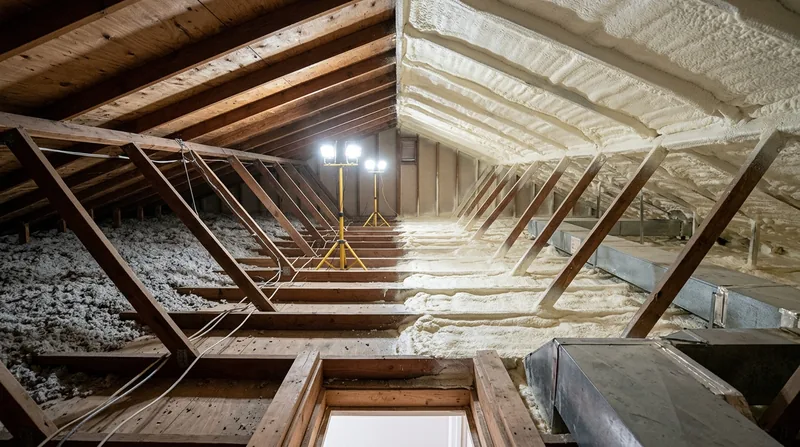




Insulation Replacement & Re-Insulation in El Paso is the reset button for attics and walls that have failed their job. In the high Chihuahuan Desert at nearly 4,000 feet, El Paso's summer heat swings from 100-degree days to monsoon roof leaks, and winter cold snaps down to freezing. Most homes sit on concrete slabs with pitched roofs that run ductwork through attics hitting 140 to 160 degrees Fahrenheit from May through September. After fifteen to twenty years, original insulation flattens, settles unevenly, or gets soaked by a roof leak or monsoon water. Rodents leave it fouled. Settling leaves gaps at the plates and rim joists where conditioned air leaks straight out. The fix is a full removal of failed material, air sealing of the gaps that killed the first installation, and new foam installed to current code R-values. This is not a patch. It is a complete reset.
Why Insulation Replacement Matters in El Paso's Desert Climate
The El Paso building stock tells the story. Kern Place and Sunset Heights hold 1900s brick bungalows and Spanish Revival homes that have sat through a century of temperature swings. Central, Northeast, and Eastside neighborhoods run 1950s to 1980s brick and block ranches, many with flat or low-slope roofs and little original attic, where the insulation that was installed has compressed and packed down to half its original thickness. The Far Eastside and Horizon City add newer two-stories with long ductwork runs through sealed attics. Every one of these homes loses money every month through an attic that has failed. The desert sun bakes a roof deck. Monsoon storms in July and August punch holes through flat roofs and soak the insulation below. Spring wind kicks dust into every unsealed attic. And when insulation is compromised, the air conditioning has to run longer and harder to cool a home, and the furnace works longer to hold heat in winter.
- Flattened or settled original insulation loses R-value and allows air to bypass it at rim joists and top plates.
- Roof leaks from monsoon storms soak fiberglass and destroy its thermal resistance until it is replaced.
- Rodent entry and nesting fouls insulation and creates health and odor problems that require complete removal.
- Dust infiltration through gaps in the attic floor and rim joists brings desert particulates into the living space.
- Ductwork running through an uncontrolled attic loses conditioned air before it reaches the rooms it was meant to cool.
A full replacement with spray foam and air sealing stops all of these failure modes at once. Check with the City of El Paso Building and Development Services for any permit requirements that apply to your address and insulation type.
Desert reality: A home in Kern Place with a 1920s brick exterior and a flat attic sitting under a parapet roof will hold monsoon heat in the walls and roof deck for hours after the sun sets. Replacing the insulation and air sealing the rim joists cuts the time the air conditioning runs after 8 PM by forty percent or more, because the attic is no longer bleeding cool air out through gaps and no longer storing the day's heat.
How Insulation Replacement & Re-Insulation Works in El Paso
The process is straightforward but requires discipline. We remove all failed insulation and haul it away. We seal air leaks at the rim joists, top plates, around ductwork penetrations, and at any other gap we find. We then install new foam to the R-value and thickness required by the current energy code in your city. Spray foam is measured on site at the board foot, and we provide a written estimate with the R-value and thickness for every area before work begins. Mechanical ventilation runs during the cure period to manage VOCs, and we set a re-entry window of twenty-four to forty-eight hours. The result is an attic or wall cavity that is sealed, insulated, and ready to work for the next fifteen to twenty years.
- We schedule a free site visit and measure the attic or wall cavity, note the current insulation type and condition, and identify air leaks.
- We provide a written estimate with R-value, thickness in inches, board-foot total, and the material cost and labor cost for your address.
- We remove all old insulation and debris, haul it away, and dispose of it per city code.
- We air seal rim joists, top plates, ductwork boots, and any other gaps using closed cell foam or sealant.
- We install new open cell or closed cell foam to the specified R-value and thickness, controlling the pass rate and drum temperature per manufacturer specs.
- We run mechanical ventilation during cure and provide a re-entry timeline before you return to the space.
This is the work we do every day across El Paso, Horizon City, Socorro, San Elizario, Canutillo, and the surrounding areas. Learn more about our attic spray foam insulation or wall and injection foam insulation services.
Local example: A 1970s ranch in the Eastside with a flat roof, low attic, and original fiberglass that has compressed to two inches in some spots and been water-damaged by a roof leak three years ago. We remove all of it, air seal the rim joists and the perimeter of the attic floor, and install four inches of closed cell foam for an R-value of 28. The attic is now sealed, insulated, and the roof deck is protected from future condensation. The job takes one day. Cost starts at $2,800 for a 1,200-square-foot attic.
Insulation Replacement & Re-Insulation Methods: Open Cell vs. Closed Cell
| Approach | Description | Best for |
|---|---|---|
| Open Cell Spray Foam | Lower density, semi-rigid, breathable, R-3.5 to R-3.6 per inch. Cures soft and allows some air and moisture vapor transmission. Lower cost per board foot. | Attics in homes where ventilation is not a concern, sound dampening, and retrofit jobs where budget is a primary factor. Requires mechanical ventilation during cure. |
| Closed Cell Spray Foam | Higher density, rigid, impermeable, R-6 to R-7 per inch. Creates an air barrier and moisture barrier in one pass. Higher cost per board foot but requires less thickness for the same R-value. | Metal buildings, sealed attics where condensation control is critical, crawl spaces, rim and band joists, and any retrofit where moisture or air infiltration is the primary failure mode. |
| Blown-In Fiberglass or Cellulose (Top-Up) | Loose fill, R-3.2 to R-3.8 per inch depending on density. Settles over time. No air sealing. Lower cost, simple installation, and does not require cure time or ventilation. | Attics with sound original insulation that simply needs depth added, or where budget constraints and no air sealing are acceptable trade-offs. Not suitable for attics with air leaks or moisture problems. |
| Removal and Disposal | Complete removal of failed insulation, debris, rodent waste, and any contaminated material. Hauled off site and disposed of per city code. Leaves a clean substrate for new installation. | Every insulation replacement job. Removal is the precondition of a durable retrofit. The cost depends on volume, access, and hauling distance. |
The choice between open cell and closed cell is not about brand loyalty or cost alone. It is about the failure mode you are fixing. In El Paso, where monsoon storms can soak an attic and summer heat bakes a roof deck to 160 degrees, closed cell foam is the right answer for sealed attics and metal buildings because it stops both air infiltration and condensation in one pass. For a simple attic that has settled and needs depth, blown-in fiberglass may be the right answer if air sealing is not the primary problem. We will tell you which one fits your home and why.
Insulation Replacement & Re-Insulation Cost in El Paso: What to Expect
The cost of a full insulation replacement starts at $2,800 for a small attic of 800 to 1,000 square feet with straightforward access and no major air sealing. Most jobs in El Paso run from $3,500 to $8,000 depending on attic size, the type of foam chosen, the extent of air sealing required, and the condition of the substrate. A 1,500-square-foot attic with closed cell foam, full rim joist sealing, and ductwork penetration sealing will run higher than a simple open cell top-up of a sound attic. The factors that move the price are attic square footage, foam type (open cell or closed cell), thickness and R-value required by your city code, the number and size of air leaks to seal, and whether ductwork or mechanical systems need to be worked around.
We provide a written estimate with the R-value, thickness in inches, board-foot total, and both material and labor cost before any work begins. This is not a range. It is a firm number for your address. Travel is included in El Paso and surrounding areas, with no separate mileage charge. The estimate is free and carries no obligation to book. Call (915) 213-7582 or visit our full pricing overview to see what other customers in your area have paid.
Getting two or three estimates is always smart. When you compare, ask each contractor for the R-value and thickness they are specifying, the board-foot total, and the breakdown of material and labor cost. A price far below the market with no written spec and no clear insurance information is a red flag. The same goes for a contractor who promises immediate re-entry or who cannot explain why ventilation is needed during cure.
What to Look for When Hiring an Insulation Replacement Contractor Near El Paso
Hiring the right contractor matters more than price alone. The spray foam market in El Paso runs the full spectrum from local independent shops to national franchises to rig-and-run crews that spray a job in an afternoon and vanish when the smell will not go away or the foam does not cure right. A good contractor is the one who shows up with a written estimate, explains the R-value and thickness they are installing, runs mechanical ventilation during cure, and is reachable if something goes wrong after the work is done. Ask any contractor for proof of insurance, a list of references, and the name of their dispatcher or office manager so you have a person to call if you need follow-up.
- Ask for a written estimate with the R-value, thickness in inches, and board-foot total specified before work begins.
- Verify that the contractor carries full insurance and ask to see a certificate of insurance naming you as an additional insured during the work.
- Check that the contractor understands your city's building code and can explain what permits apply to your address and whether they will help you navigate the permitting process.
- Get the names and phone numbers of three recent customers in El Paso or nearby and call them to ask about the quality of the work and the contractor's responsiveness after the job was done.
- Ask the contractor to explain how they will manage VOCs during cure, what re-entry window they recommend, and what mechanical ventilation they will run.
- Confirm that the contractor will remove all old insulation and haul it away, and that they will air seal gaps before installing new foam.
The strongest signal of a good contractor is one who tells you when spray foam is not the right answer. If your attic is wet or has standing water, a good contractor will fix the moisture first or walk away. If you have a simple attic that has settled and just needs depth, a good contractor might recommend blown-in fiberglass instead of foam. If you have a flat roof with a history of leaks, a good contractor will tell you that insulation does not fix the roof and that you need a roofer first. This kind of honest guidance is what separates a local shop from a franchise or a crew that just wants to spray and move on. Contact us at our contact page for a free estimate and to speak with someone who knows the El Paso market.
Insulation Replacement & Re-Insulation in El Paso: Pricing Guide
| Service | Price | Details |
|---|---|---|
| Small attic replacement | Starting at $2,800 | 800 to 1,000 square feet, open cell foam, straightforward access, minimal air sealing required |
| Standard 1,200 to 1,500 sq ft attic | Starting at $4,200 | Closed cell or open cell foam, full rim joist and top plate sealing, ductwork penetration sealing included |
| Large attic or sealed roof deck | Starting at $6,500 | 1,600 square feet or more, closed cell foam, extensive air sealing, condensation control, or structural complexity |
| Wall or injection foam retrofit | On estimate | Requires on-site assessment of wall cavity depth, existing insulation type, and access points before pricing |
| Crawl space or rim joist replacement | Starting at $1,800 | Depends on linear feet of rim joist, crawl space square footage, and moisture conditions on site |
| Free estimate and site visit | No charge | Response within 24 hours, written spec with R-value and thickness, no obligation to book, call (915) 213-7582 |
Indicative pricing, the exact cost depends on square footage, finish, and site access. Free personalized estimate within 24h at (915) 213-7582.


