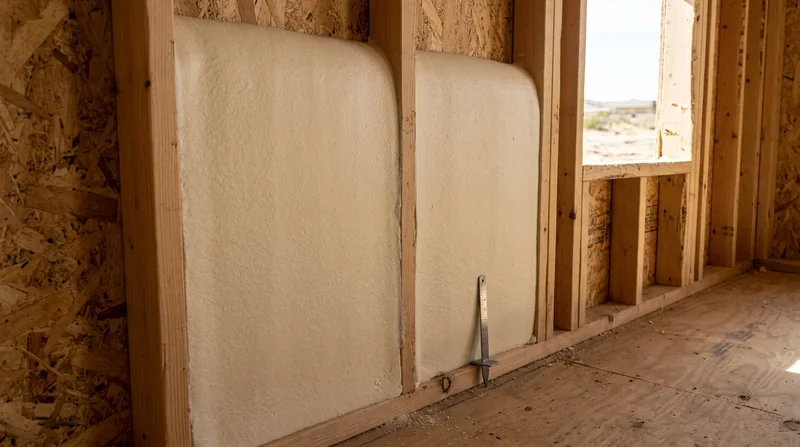




Closed cell spray foam insulation in El Paso is engineered for the desert's harshest conditions. The high Chihuahuan Desert wraps around the Franklin Mountains at nearly 4,000 feet, and summer heat routinely climbs past 105 degrees Fahrenheit while winter nights drop to freezing. Nearly every home sits on a concrete slab with brick, block, or stucco walls, and above the pitched roofs of older neighborhoods or the flat-roof ranches that dominate the Eastside and Lower Valley, attics and roof decks are exposed to temperature swings that stress traditional fiberglass and open-cell foam. Two-pound closed-cell foam delivers R-6.5 per inch with its own vapor retarder and real structural stiffening, making it the right product for metal buildings, low-slope roof decks, exterior walls, and anywhere El Paso's desert swing hits hardest. Since 2012, we have sprayed closed-cell foam in Kern Place Victorians, Sunset Heights bungalows, Eastside ranches, Far East two-stories, and farm buildings across Canutillo, Clint, Fabens, and Horizon City. Get a free, written estimate with R-value and thickness specifications by calling (915) 213-7582 or visiting our contact page.
Why Closed Cell Spray Foam Works in El Paso's Desert Climate
El Paso's summer heat and winter freeze create two distinct insulation challenges. Attics in pitched-roof homes climb to 140 to 160 degrees Fahrenheit from May through September, driving cooling load and causing traditional insulation to settle and lose R-value. Flat-roof ranches and low-slope parapet roofs across the Eastside and Lower Valley collect heat on the roof deck itself, and the thermal gradient between inside and outside demands a product that resists vapor transmission. Closed-cell foam stops both heat transfer and air infiltration in a single pass, and its structural rigidity reinforces the roof deck against the spring wind that kicks dust into every unsealed attic.
- Closed-cell foam delivers R-6.5 per inch, requiring less thickness than open-cell to meet code in high-load zones.
- The built-in vapor retarder prevents moisture from condensing on metal roof decks and metal building walls during the desert swing.
- Closed-cell foam stiffens roof decks and roof trusses, reducing deflection on flat roofs and low-slope decks common in El Paso.
- The product resists the summer monsoon: a sealed roof deck sheds water rather than absorbing it into fiberglass or open-cell foam.
- Closed-cell foam holds its R-value across temperature extremes, unlike fiberglass, which settles and loses performance as it ages.
These advantages make closed-cell foam the standard choice for metal farm buildings in the Canutillo, Clint, and Fabens farm belt, and for the sealed roof decks and metal buildings that are rising across Horizon City and the Far East.
Key info: El Paso's building code and thermal barrier requirements are set by the local building official in your jurisdiction (City of El Paso, City of Horizon City, Town of Anthony, or your county). The fifteen-minute thermal barrier distinction between closed-cell and open-cell foam is real and is enforced on permit. Ask your contractor to name it correctly and to verify what applies at your address before the first spray.
For more detail on how closed-cell foam compares to open-cell options, see our guide to open cell spray foam insulation.
How We Install Closed Cell Spray Foam in El Paso Homes and Buildings
Closed-cell foam installation begins with site assessment and moisture control. We inspect the substrate (attic floor, roof deck, wall cavity, crawl space wall, or metal building frame) for existing moisture, active leaks, or contamination. If the surface is wet or compromised, we do not spray and we walk away. A dry substrate is the only foundation for a durable foam installation. Once the area is ready, we prepare the space by sealing and protecting HVAC ducts, electrical boxes, and vents, then set up mechanical ventilation to control fumes during the spray and cure process.
- We verify the substrate is dry, sound, and free of contamination before any foam is sprayed.
- We set up mechanical ventilation and establish a re-entry window of 24 to 48 hours, posted on site and communicated in writing.
- We spray closed-cell foam in controlled passes, maintaining the manufacturer's specified ratio and drum temperature to ensure density and R-value.
- We measure board-foot thickness on site and document the R-value and coverage in the written estimate and the final invoice.
- We trim and finish the foam flush with the framing, leaving no overspray or voids that compromise the thermal or air-sealing performance.
The entire process is transparent: you receive a written estimate with R-value and thickness before we begin, and a final invoice that specifies what was installed. For attic work, this process typically takes one to two days depending on square footage and access. For wall cavities or crawl spaces, the timeline depends on the size and complexity of the cavity.
Example: A 1,200-square-foot attic in a Sunset Heights brick bungalow with a pitched roof and existing blown-in fiberglass requires 4 to 6 inches of closed-cell foam to achieve R-38 to R-60 and a sealed roof deck. The job takes one to two days, and the homeowner can re-enter after 48 hours. A flat-roof Eastside ranch with a low attic and hot west-facing walls may need 6 inches on the roof deck and 4 inches on the west-facing wall cavity, sprayed in the same visit.
See our attic spray foam insulation page for details on sealed attic work, or our metal building and barndominium spray foam page for agricultural and commercial applications.
Closed Cell Spray Foam Installation Methods in El Paso
| Application | Description | Best for in El Paso |
|---|---|---|
| Sealed Attic Roof Deck | Closed-cell foam sprayed directly to the underside of the roof sheathing, creating an unvented, conditioned attic. R-value 4 to 6 inches, typically R-24 to R-38. | Pitched-roof homes in Kern Place, Sunset Heights, and Manhattan Heights; older brick bungalows with hot attics and ductwork running through unconditioned space. |
| Low-Slope Roof Deck Foam | Closed-cell foam sprayed on the interior of flat or low-slope roofs, bonding directly to the deck and creating a sealed, condensation-resistant envelope. R-value 5 to 8 inches. | 1950s-80s Eastside and Lower Valley ranches with flat roofs and parapet walls; newer Far East two-stories with low-slope decks and long duct runs. |
| Exterior Wall Cavity Foam | Closed-cell foam injected into brick, block, or frame-and-stucco exterior walls to seal air leaks and add thermal resistance without demolition. Typically 2 to 3 inches. | West-facing walls in Eastside ranches and Far East two-stories; brick walls in older neighborhoods where summer heat load is extreme. |
| Metal Building Shell Foam | Closed-cell foam sprayed on the interior of metal building walls and roof decks, preventing condensation and resisting moisture in high-temperature-swing environments. Typical coverage 4 to 6 inches. | Farm buildings and pecan sheds in Canutillo, Clint, and Fabens; barndominiums and shops in Montana Vista and Homestead Meadows; cross-border logistics warehouses. |
| Crawl Space Wall and Band Joist Foam | Closed-cell foam applied to band joists, rim joists, and crawl space walls to seal the thermal envelope and control moisture. Typically 2 to 4 inches on vertical surfaces. | Kern Place and Sunset Heights homes with raised floors and crawl spaces; older brick bungalows where band joists are exposed to desert temperature swings. |
Closed Cell Spray Foam Insulation Cost in El Paso: What to Expect
Closed-cell spray foam is priced per board foot, which is the volume of foam measured on site: thickness in inches multiplied by square footage, divided by 12. A typical El Paso attic or roof deck job starts at $1.20 per board foot and moves upward based on substrate condition, access, complexity, and the scope of air sealing required. A 1,200-square-foot attic sealed to R-38 with 5 inches of closed-cell foam runs approximately 500 board feet, or $600 to $800 before any wall or rim joist work. A metal building with 6 inches of foam on walls and deck across 3,000 square feet could run 1,500 board feet or more, depending on the framing and the amount of trim work required.
Several factors move the price up or down. If the substrate is wet, contaminated, or requires structural repair before foam can be applied, we address that first or we walk away. If the attic or roof deck has existing insulation that is failed, settled, or contaminated, we remove it before spraying (see our insulation removal page for details). If the job requires extensive air sealing around ducts, electrical penetrations, or roof vents, the board-foot count increases. If access is difficult (a steep pitch, tight crawl space, or a complex roof geometry), labor time increases and the per-board-foot cost may rise.
The best way to understand cost for your specific home or building is to get a written estimate with R-value and thickness specified. We provide free estimates within 24 hours at (915) 213-7582. We recommend getting two or three estimates from different contractors so you can compare not just price but the specifics of what is being installed. A low estimate with no R-value specification, no thickness, and no mention of substrate preparation is a red flag. For a detailed pricing overview and examples, see our full pricing page.
What to Look for When Hiring a Closed Cell Spray Foam Contractor Near Me in El Paso
Choosing the right spray foam contractor is more important than price alone. The product is only as good as the installation, and a poorly sprayed foam job can create odor, incomplete coverage, or inadequate thermal performance that you will live with for years. El Paso is served by both local independent shops and national franchise crews, and by transient rig-and-run operators who spray a job in an afternoon and are unreachable when the smell will not go away. The way to verify any contractor, including us, is simple and concrete.
- Ask for a written estimate that specifies R-value per inch, total thickness in inches, and board-foot coverage, not just a dollar amount.
- Verify that the contractor is fully insured and ask for a certificate of insurance naming your address or the work location as additional insured.
- Ask whether the contractor will establish mechanical ventilation during cure and post a re-entry window of 24 to 48 hours on site.
- Request references from at least two completed jobs in El Paso or the surrounding area, and call them to ask about odor, cure time, and whether the contractor was reachable after the work was done.
- Confirm with your local building department (City of El Paso, City of Horizon City, or your municipality) whether a permit is required for the work and whether the contractor holds the contractor registration your city requires.
- If your home is in an HOA, check your architectural rules to confirm that insulation work is permitted and whether exterior work on metal buildings requires approval.
A contractor who hesitates to put R-value and thickness in writing, who promises immediate re-entry, or who cannot provide verifiable insurance is not the right fit. The local independent contractor with a local address, local plates, and honest guidance on whether you need closed-cell or open-cell foam, or even blown-in insulation on top of what you have, is the contractor who will stand behind the work. Contact us at (915) 213-7582 or visit our contact page for a free estimate and references from homes and buildings near you.
Closed Cell Spray Foam Insulation in El Paso: Pricing Guide
| Service | Price | Details |
|---|---|---|
| Attic or Roof Deck Sealing | Starting at $1.20/board ft | Sealed attic or low-slope roof deck, 4 to 6 inches, R-24 to R-38. Includes substrate prep and air sealing around penetrations. |
| Metal Building or Pole Barn | Starting at $1.20/board ft | Interior spray on walls and roof deck, 4 to 6 inches, condensation control. Larger buildings may see lower per-board-foot rates due to volume. |
| Wall Cavity or Injection Foam Retrofit | Starting at $1.35/board ft | Exterior wall injection without demolition, 2 to 3 inches. Higher labor and equipment cost due to cavity access and precision required. |
| Crawl Space Walls and Band Joists | Starting at $1.25/board ft | Vertical spray on rim and band joists, crawl space walls, 2 to 4 inches. Access and cramped working space drive labor cost. |
| Insulation Removal Before Spray | On estimate | Removal of failed fiberglass, blown-in cellulose, or old foam is priced separately based on volume, contamination, and disposal. |
| Free Estimate and Travel | No charge | Written estimate with R-value and thickness specs. Travel included in El Paso and surrounding service areas, 24-hour response. |
Indicative pricing, the exact cost depends on square footage, finish, and site access. Free personalized estimate within 24h at (915) 213-7582.


