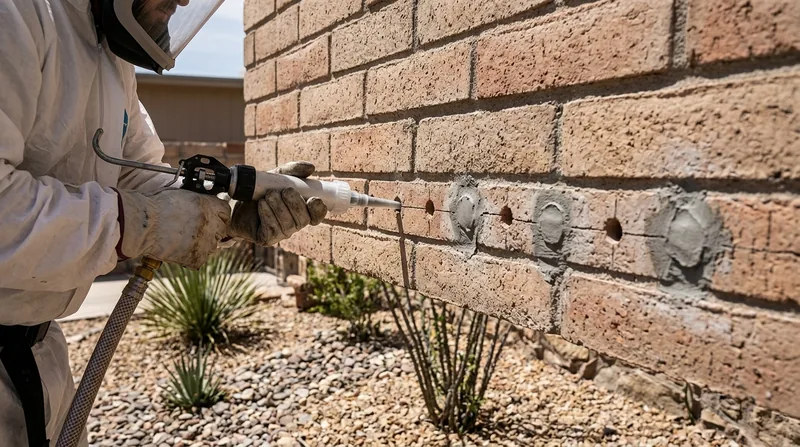




Wall & Injection Foam Insulation in El Paso fills the hollow cores of concrete block walls and the empty cavities of frame-and-stucco homes without demolition. In El Paso's high desert climate, where summer temperatures routinely exceed 100 degrees and winter swings drop to freezing, the hollow cavities in pre-1980 residential construction become thermal highways that bleed conditioned air straight through the walls. The 1950s-80s brick and block ranches that dominate the Central, Northeast, Eastside and Lower Valley neighborhoods were built with these cavities left empty, and the newer stucco two-stories of the Far East side and Horizon City often share the same thermal weakness. Injection foam reaches into those cavities and seals them solid, stopping the convection that makes your cooling work twice as hard. No walls come down. Ports are drilled, foam is injected at controlled pressure, and the holes are patched to blend. For El Paso homeowners tired of hot west-facing walls and energy bills that climb with the thermometer, injection foam is the retrofit that works.
Why Injection Foam Insulation Matters in El Paso's Desert Heat
El Paso sits at nearly 4,000 feet in the high Chihuahuan Desert, where the sun beats down relentlessly from May through September and the thermal mass of concrete block and brick walls absorbs and radiates that heat into your home all night. A hollow concrete block wall with no insulation conducts heat at roughly R-0, meaning the temperature difference between outside and inside is transmitted almost directly through the wall assembly. In a 120-degree afternoon, that translates to interior wall temperatures climbing 30, 40, even 50 degrees above ambient room temperature. Injection foam raises the R-value of that same wall to R-3.5 to R-5, depending on the foam type and cavity depth, and stops the heat transfer cold. The result is lower cooling load, lower thermostat cycling, and lower utility bills through the worst months of the year.
- Hollow concrete block walls in El Paso's post-war housing stock conduct heat at R-0 without insulation, making west-facing walls a primary thermal liability.
- Injection foam fills those cavities without removing any wall material, preserving the structural integrity and exterior finish of brick or stucco.
- A properly injected wall in El Paso can reduce peak wall surface temperature by 20 to 35 degrees Fahrenheit, cutting cooling load in summer and heat loss in winter.
- The process is complete in a single day, with no interior drywall disturbance, no dust, and no disruption to landscaping or driveways.
- Injection foam also reduces air infiltration through wall cavities, which in El Paso's spring wind season prevents dust and pollen from being driven into wall cavities and attics.
For El Paso homes built between 1950 and 1990, injection foam is the most cost-effective way to address the hollow-wall thermal penalty that air conditioning alone cannot solve.
Local example: A 1960s brick ranch in the Eastside with 2,000 square feet of exterior wall and hollow block cavities running 3.5 inches deep can accept roughly 2,500 to 3,000 board feet of injection foam. At El Paso summer conditions, that retrofit typically reduces cooling load by 12 to 18 percent and lowers wall surface temperature by 25 to 30 degrees on the west and south faces. The job takes one day and costs from $2,500 to $4,000 depending on cavity accessibility and foam type.
How Injection Foam Insulation Works in El Paso Homes
Injection foam insulation is a retrofit technique designed for walls that are already built. The hollow cavities in concrete block, brick veneer over block, and frame-and-stucco construction are accessed by drilling small ports (typically 1 inch diameter) through the exterior finish at regular intervals. Foam is injected under controlled pressure into each cavity, expanding to fill the void and curing solid. The ports are then patched with mortar or caulk and painted to match the surrounding wall. In El Paso, where most residential walls are concrete block or brick, the process is straightforward. Solid adobe walls, common in Segundo Barrio, Ysleta and Socorro, cannot be injected because they have no hollow cavities, and double-brick walls with no air gap are also not candidates. The key is identifying which walls have cavities and which do not before any drilling begins.
- We locate the wall type and cavity depth by examining the wall section, checking block dimensions, and probing test holes to confirm cavity size and condition.
- We drill injection ports at intervals of 16 to 24 inches vertically and horizontally, spaced to ensure complete fill without foam waste or bridging.
- We inject closed-cell polyurethane foam at the proper drum temperature and mix ratio, with mechanical ventilation running during the entire application to control fumes and off-gassing.
- We allow the foam to cure fully (typically 24 to 48 hours) before we patch and paint the ports, leaving the wall finish seamless and indistinguishable from the original.
- We document the board footage injected, the cavity depth, the R-value achieved, and the re-entry window in writing for your records and for any permit compliance your city requires.
For more information on the closed-cell foam we use for injection work, visit our Closed Cell Spray Foam Insulation page.
Example from Socorro: A 1970s block home on the east side of Socorro with 1,200 square feet of hollow-core exterior walls required injection at 18-inch port spacing. We drilled 48 ports, injected 1,800 board feet of closed-cell foam, and patched all ports with color-matched mortar. Total time on site: 6 hours for injection, 2 hours for patching and curing management. The homeowner saw no interior disruption and no exterior damage beyond the patched drill holes.
Injection Foam Methods and Applications
| Approach | Description | Best for |
|---|---|---|
| Closed-Cell Injection | High-density polyurethane foam injected into hollow cavities at 2.0 PCF, expanding to fill the void and curing to R-6.5 per inch. | Hollow concrete block, frame-and-stucco, and brick veneer walls in El Paso's desert climate where vapor control and thermal performance are both critical. |
| Cavity Fill with Thermal Barrier | Closed-cell foam injected with an intumescent or thermal barrier coating applied to the interior face of the cavity to meet the fifteen-minute thermal barrier requirement of the building code. | Any wall cavity in El Paso where the building code in force at your address requires a thermal barrier between the foam and the interior living space. |
| Retrofit Injection with Minimal Disruption | Drilling and injecting from the exterior only, with no interior wall disturbance, interior drywall patching, or interior access required. | Occupied homes, rental properties, and any El Paso residence where interior access is limited or where minimizing disruption is a priority. |
| Selective Injection (Hot Walls Only) | Injecting only the west and south-facing walls that experience the highest solar load in El Paso's desert sun, leaving cooler walls untouched to reduce cost. | Budget-conscious homeowners in El Paso who want to prioritize the walls that contribute most to summer cooling load and defer other walls to a later phase. |
Wall & Injection Foam Insulation Cost in El Paso: What to Expect
Wall injection foam insulation in El Paso typically costs from $2 to $3.50 per square foot of wall area, with the final price depending on cavity depth, wall type, accessibility, and whether a thermal barrier is required by your city's building code. A 2,000-square-foot home with 1,500 square feet of injectable exterior wall can expect a retrofit cost of $3,000 to $5,250. The largest cost variables are cavity depth (deeper cavities hold more foam and cost more), the presence of obstacles like electrical outlets or previous poor insulation work (which requires careful removal), and the number of stories (multi-story homes require scaffolding or lift equipment, which adds labor). Getting written estimates from two or three contractors is the only way to understand what your specific walls will cost, because every home in El Paso has a different wall assembly, a different cavity condition, and different code requirements depending on which city or neighborhood you live in.
Visit our full pricing overview to see how injection foam compares to other insulation options and to understand the factors that move cost up or down for your particular home.
What to Look for When Hiring a Spray Foam Contractor Near Me in El Paso
Hiring a spray foam and injection foam contractor in El Paso requires the same due diligence as hiring any tradesperson. The market includes local independents, national franchise operations, and transient crews that spray a job in an afternoon and are unreachable when problems arise. The best way to separate them is to ask the right questions before you sign anything. First, ask for a written estimate that includes the R-value per inch, the expected cavity fill depth, the board footage to be installed, and the re-entry window after curing. If a contractor cannot or will not provide these details in writing, move on. Second, ask whether mechanical ventilation will run during the entire application and for how long afterward. Proper ventilation during cure is the difference between a home that is safe to re-enter in 24 to 48 hours and one that smells for weeks. Third, ask for proof of current general liability insurance and request to be named as an additional insured on the certificate. You can verify the certificate by calling the insurance company directly. Fourth, check whether your city requires contractor registration and ask the contractor to confirm their registration number with you before they start. In El Paso, the City of El Paso does not require contractor registration for insulation work, but neighboring cities like Horizon City, Socorro, and San Elizario may have different rules, so always verify with your local building department. Fifth, understand that permits for injection foam work vary by city and by code, and confirm with your contractor and your city whether a permit is required before any drilling begins.
- Request a written estimate that specifies R-value, cavity depth, board footage, and re-entry window in clear language, not vague promises.
- Confirm that mechanical ventilation will run during the entire application and ask how long the ventilation will continue after spraying stops.
- Ask for proof of current general liability insurance and request to see the certificate before work begins.
- Verify that the contractor is registered with your city if registration is required, and ask for the registration number to confirm it yourself with the city.
- Confirm with your local building department whether a permit is required for injection foam work at your address and ask the contractor to help you understand what applies.
- Ask for references from three previous El Paso customers and call them to ask whether the contractor completed the work on schedule, stayed within budget, and was reachable for follow-up questions after the job was done.
For a free, no-obligation estimate and a conversation with a local El Paso contractor, contact us today or call (915) 213-7582. We respond within 24 hours and provide written estimates with full specifications for every job.
Wall & Injection Foam Insulation in El Paso: Pricing Guide
| Service | Price | Details |
|---|---|---|
| Hollow Concrete Block Injection | Starting at $2.00/sq ft | Standard cavity fill in 3.5-inch block with closed-cell foam, includes drilling, injection, patching, and curing management for El Paso homes |
| Frame-and-Stucco Retrofit | Starting at $2.50/sq ft | Injection into 1.5-inch to 3.5-inch frame cavities, typically requires more ports and careful pressure control to avoid stucco cracking or interior drywall damage |
| Thermal Barrier Application | Add $0.50 to $1.00/sq ft | Intumescent or thermal barrier coating on interior cavity face to meet fifteen-minute thermal barrier requirement of El Paso building code where applicable |
| Multi-Story or Difficult Access | On estimate | Second-story walls, walls adjacent to rooflines, or cavities blocked by previous insulation require scaffolding, lift equipment, or specialized drilling techniques that must be assessed on site |
| Estimate and Site Inspection | Free | We visit your El Paso home, identify wall types and cavity conditions, measure square footage, and provide a written estimate with R-value and board footage within 24 hours at no cost or obligation |
Indicative pricing, the exact cost depends on square footage, finish, and site access. Free personalized estimate within 24h at (915) 213-7582.


