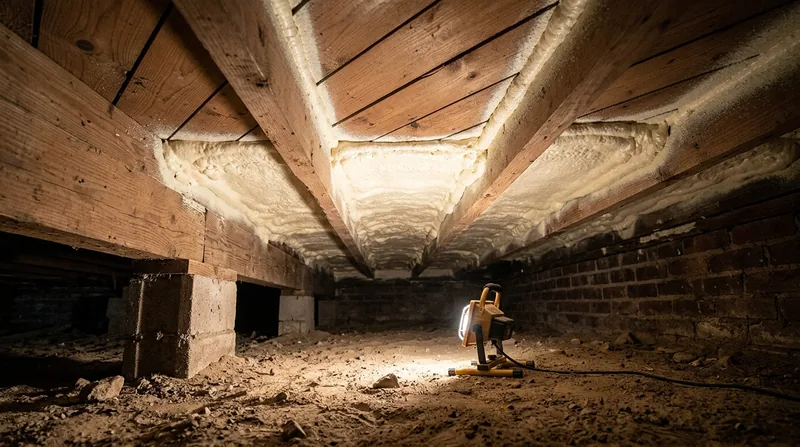




Most El Paso homes sit on concrete slab, but the older brick bungalows and Spanish Revival homes in Kern Place, Sunset Heights, and Manhattan Heights were built on raised floors with crawl spaces underneath. Those crawl spaces are cold in winter, dusty year-round from the desert wind, and prone to temperature swings that make floors feel frigid on freezing nights. Crawl Space Spray Foam Insulation in El Paso seals the subfloor with closed-cell foam, stops cold air infiltration, keeps dust and desert debris out of the living space above, and protects the structure from moisture problems that can rot rim joists and band joists. We handle crawl space insulation for historic neighborhoods across El Paso, from the Rim to Sunset Heights to Canutillo and beyond. The work is straightforward: we assess moisture first, seal and insulate the subfloor and rim band with foam, and leave you with a warmer, tighter home.
Why Crawl Space Insulation Matters in Historic El Paso Homes
Older homes with raised floors were built when energy codes did not exist. The crawl space underneath was ventilated to the outside, which made sense for moisture control in a humid climate, but El Paso is a high desert where the air is dry most of the year and winter nights drop to freezing. Open ventilation pulls cold air directly under the floor, and dust from the surrounding desert gets sucked into the insulation and into the home. Cold floors make heating less effective and drive up utility bills. Rim joists and band joists exposed to the crawl space air lose heat rapidly and are vulnerable to moisture damage when winter condensation forms on cold surfaces.
- Closed-cell foam on the subfloor creates a thermal break and stops cold air from rising into the living space above.
- Foam seals gaps and cracks in the rim joist and band joist, which are the primary air leakage paths in older construction.
- The foam acts as a moisture and dust barrier, keeping desert air and debris out of the crawl space.
- A properly insulated crawl space reduces the load on your heating system and lowers utility costs in winter.
Homes in Kern Place and Sunset Heights with original crawl space insulation often have deteriorated fiberglass or mineral wool that has settled, compacted, or absorbed moisture. Replacing it with closed-cell foam is the modern answer.
Key info: Moisture problems must be fixed before foam is applied. If the crawl space has standing water, active seepage, or a wet substrate, we address the source first or recommend a separate moisture control specialist. We do not spray over wet surfaces, and we do not encapsulate crawl spaces. Proper ventilation and drainage are the foundation; foam is the insulation layer that goes on top of a dry, stable surface.
For more on how closed-cell foam works as an insulation product, see our page on closed-cell spray foam insulation.
How We Insulate Crawl Spaces in El Paso: The Process
Crawl space insulation starts with a site inspection. We look at the subfloor, rim band, and band joist; check for signs of moisture or past water damage; confirm that the crawl space is dry and ready for foam; and measure the area to be insulated. We then discuss R-value requirements, foam thickness, and the best approach for your home's layout. Once you approve the estimate, we schedule the work and arrive with our spray rig, hoses, and safety equipment.
- We inspect the crawl space for moisture, standing water, or structural damage before any foam is applied.
- We lay out the spray pattern and prepare the subfloor and rim band surfaces for adhesion.
- We spray closed-cell foam in controlled passes, building up thickness to meet the R-value specified in your estimate.
- We ensure proper ventilation during cure, typically 24 to 48 hours before the space is occupied or used.
- We verify coverage and thickness on site and provide you with a written record of the work performed.
The entire job is usually completed in one day, depending on crawl space size and access. You will notice warmer floors within days and a reduction in dust and drafts.
Example: A 1920s brick bungalow in Sunset Heights with a 600-square-foot crawl space under the main living area receives 2 inches of closed-cell foam on the subfloor and rim band, bringing the R-value to approximately R-13. The homeowner notices warmer floors by the second week of winter, and the utility bill for January is 12 percent lower than the prior year. The crawl space stays dry and dust-free because the foam seals the air leakage path that was pulling in desert air.
Learn more about how we handle rim joist and band joist insulation, which is often part of a crawl space project.
Crawl Space Insulation Methods: Closed-Cell Foam vs. Open-Cell and Alternatives
Crawl spaces require a vapor barrier and moisture control, which makes closed-cell foam the standard choice. Open-cell foam is permeable and is not suitable for below-grade or below-floor applications where moisture risk is present. Fiberglass batts and blown-in mineral wool are cheaper but do not air-seal, do not provide a vapor barrier, and deteriorate quickly in crawl spaces where dust and temperature swings are extreme.
| Approach | Description | Best for |
|---|---|---|
| Closed-Cell Spray Foam | High-density foam applied in thin layers, building to R-13 to R-21 per 2 inches. Includes a vapor barrier and air seal in one application. | Historic homes with raised floors, crawl spaces with temperature swings, and any home where dust control and moisture protection are priorities. |
| Open-Cell Spray Foam | Lower-density foam that is permeable. Does not act as a vapor barrier and allows moisture to pass through. | Not recommended for crawl spaces or below-floor applications in any climate. |
| Fiberglass Batts or Blown-In Mineral Wool | Bulk insulation with no air seal. Settles, compacts, and absorbs dust and moisture over time. Requires a separate vapor barrier and air sealing. | Attics only, and only in homes where air sealing is handled separately. Not suitable for crawl spaces. |
| Existing Insulation Removal and Replacement | We remove failed or contaminated insulation from the crawl space and replace it with closed-cell foam in one project. | Homes where the original crawl space insulation has deteriorated, settled, or absorbed moisture and dust. |
Closed-cell foam is the only choice for crawl spaces in El Paso because it provides the air seal, the vapor barrier, and the durability that the desert climate and the age of most raised-floor homes demand.
Crawl Space Spray Foam Insulation Cost in El Paso: What to Expect
Crawl space insulation pricing depends on the size of the space, the condition of the subfloor and rim band, the R-value required, and access. A typical crawl space under a historic home in Kern Place or Sunset Heights runs 400 to 800 square feet. Closed-cell foam at 2 inches thick (R-13) or 3 inches (R-19 to R-21) is the standard specification. Moisture issues, if present, must be resolved before foam is applied, which may add cost or timeline. Getting 2 to 3 estimates is always smart because scope, R-value, and local factors vary.
Crawl space insulation typically starts at $2,500 for a smaller space with good access and no moisture remediation needed. Larger spaces, difficult access, or moisture work will increase the cost. See our pricing page for more detail on how we structure estimates and what factors move the price up or down.
We provide written estimates that specify the R-value, thickness, and square footage so you know exactly what you are paying for. We also help you understand what your city may require in terms of permits or thermal barriers, and we defer to the local building official on any code question.
What to Look for When Hiring a Spray Foam Insulation Contractor Near Me in El Paso
Choosing a spray foam contractor is an important decision because the work affects your home's comfort and energy efficiency for years. A good contractor asks questions, provides a written estimate with R-value and thickness, explains the process, and stands behind the work. A bad contractor shows up with a price but no details, promises immediate re-entry, and disappears after the job is done. Here is what to verify when you call any spray foam contractor, including us.
- Ask for a written estimate that specifies the R-value, thickness in inches, and square footage of the insulation to be applied.
- Confirm that the contractor is fully insured and ask for a certificate of insurance naming your address as the location of work.
- Check that the contractor understands your city's permit requirements and thermal barrier rules, and ask how they handle permitting at your address.
- Request references from recent crawl space projects in El Paso or nearby areas, and call at least two to ask about the work and the experience.
- Verify that mechanical ventilation will be used during the spray and cure, and that a 24 to 48 hour re-entry window is stated in writing.
- Choose a contractor who inspects the space in person before quoting and puts the scope, thickness and R-value in writing.
We welcome your questions and are happy to provide references and insurance details. Contact us for a free estimate at (915) 213-7582, and we will walk you through the process and answer any concerns you have about the work.
Crawl Space Spray Foam Insulation in El Paso: Pricing Guide
| Service | Price | Details |
|---|---|---|
| Small crawl space, 300-500 sq ft, closed-cell foam | Starting at $2,500 | Two inches of closed-cell foam on subfloor and rim band, R-13 value, includes labor and materials |
| Medium crawl space, 500-800 sq ft, closed-cell foam | Starting at $4,200 | Three inches of closed-cell foam for R-19 to R-21, subfloor and rim band coverage, full air seal |
| Large crawl space or complex access | On estimate | Spaces over 800 sq ft, difficult crawl access, or moisture remediation required; site inspection determines final price |
| Insulation removal and replacement | Starting at $1,800 | Removal of failed fiberglass or mineral wool, disposal, and replacement with closed-cell foam in one project |
| Free estimate and site inspection | Free | Response within 24 hours at (915) 213-7582, no obligation to book, written quote with R-value and thickness |
Indicative pricing, the exact cost depends on square footage, finish, and site access. Free personalized estimate within 24h at (915) 213-7582.


